Make your own Secret Santa draw
Secret Santa ·
Hi
Check that nobody else can see your screen.
You are buying a gift for
- Budget
- Exchange date
- Note
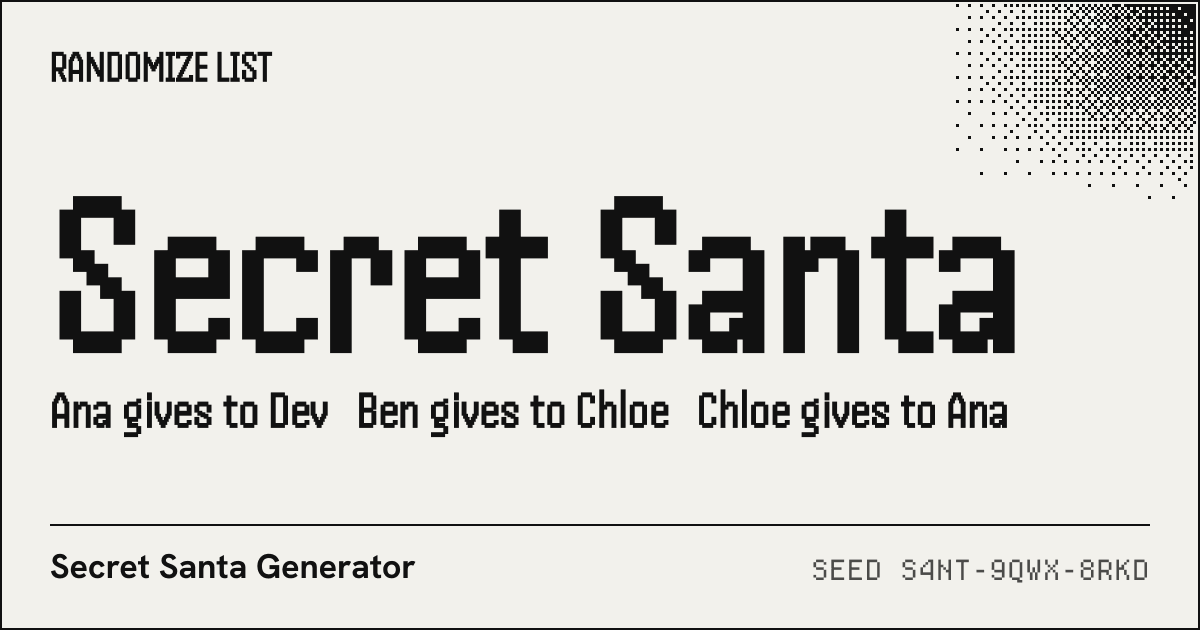
The organizer made this card with the Secret Santa generator on this page. The names are stored in the link itself; nothing was sent to a server.
Secret Santa Generator
Enter everyone’s name, one per line, put couples or households you want kept apart under Keep apart, and press Draw. This Secret Santa generator gives every person someone else to buy for, never themselves, then makes a link for each giver that shows only their own match. You send the links yourself; nothing is emailed or stored.
List options
Use your own seed
The same list, settings and seed always give the same result. A code such as K7Q2-9MXD-4HCZ is read in any case; other text is used exactly as typed.
Ctrl + Enter draws; R draws again when you are not typing.
Result
Paste a list and press Draw. The result appears here, the first name largest.
- 01 Ana gives to Dev
- 02 Ben gives to Chloe
- 03 Chloe gives to Ana
- 04 Dev gives to Gus
- 05 Eli gives to Ben
- 06 Farah gives to Eli
- 07 Gus gives to Hana
- 08 Hana gives to Farah
Anyone with the link can see the list. The part after # is not sent to any server.
A link for each person, to send by WhatsApp, iMessage or email
Not encrypted: whoever opens a link, you included, sees the name.
Recent draws on this device
How do I run a Secret Santa draw online?
- List everyone. Type or paste every name, one per line. Names must differ, so add an initial when two people share one.
- Keep couples and households apart. Under Keep apart, put a couple on one line, such as Ana, Ben. Three or more names on a line are a household: nobody in it draws anyone else in it. Farah > Gus stops Farah drawing Gus again, while Gus may still draw Farah.
- Add the details. Optionally open Details for every card and fill in the budget, the exchange date, a note and the group name; they appear on every card. If you are taking part yourself, tick Hide the result from me.
- Draw and send the links. Press Draw, then Links for each person. Send every person their own link on WhatsApp, iMessage or another messenger, or by email, or download a CSV of givers and links for a mail merge. No email addresses are collected.
Nobody ever draws their own name: the generator only accepts an arrangement in which every giver has someone else, which is the same rule, a derangement, that the explanation of the method counts for groups of 3 to 20.
How many exchanges are left when couples are kept apart?
Every couple you keep apart removes the arrangements in which one partner draws the other. The table counts what is left, exactly, for 6 to 12 people and up to three couples. The couples are separate pairs of people; a household of three counts as three such pairs. Even three couples in a group of six leave 80 possible exchanges, so the draw stays fast and every allowed exchange keeps the same chance.
| People | No couples | 1 couple | 2 couples | 3 couples |
|---|---|---|---|---|
| 6 | 265 | 168 | 116 | 80 |
| 7 | 1,854 | 1,280 | 920 | 672 |
| 8 | 14,833 | 10,860 | 8,132 | 6,176 |
| 9 | 133,496 | 101,976 | 78,976 | 61,792 |
| 10 | 1,334,961 | 1,053,136 | 838,324 | 672,240 |
| 11 | 14,684,570 | 11,881,152 | 9,672,904 | 7,917,280 |
| 12 | 176,214,841 | 145,510,740 | 120,695,300 | 100,511,168 |
In a group of 8, each couple removes 24.1% to 26.8% of the exchanges that were left, and the count falls from 14,833 to 6,176 with three couples apart; smaller groups lose a larger share. When no exchange is left at all, the tool says which people are boxed in instead of drawing something that breaks your rules; the check behind that message is Hall’s marriage theorem.
One circle or any exchange?
By default the result can split into several small loops: Ana and Ben may simply swap gifts while the others form a ring of their own. Tick One circle and the givers form a single chain, A to B to C and back to A, which suits a gift exchange where each present is opened in turn. A single chain is a narrower choice, as this comparison with two couples kept apart shows:
| People | Any exchange | One circle | Circles among all exchanges |
|---|---|---|---|
| 6 | 116 | 48 | 41.4% |
| 8 | 8,132 | 2,640 | 32.5% |
| 10 | 838,324 | 221,760 | 26.5% |
| 12 | 120,695,300 | 26,853,120 | 22.2% |
A single circle is not slower to find, though. In One circle mode a shuffle is read as a seating order around a table, so nobody can land on themselves to begin with; for 8 people with two couples, 52.4% of shuffles already give a valid circle, against 20.2% for any exchange. Either way the tool redraws until the rules hold, so the result is uniform among the arrangements that fit.
Small groups: two, three or four people
With two people there is 1 exchange: they swap. Three people have 2, and both are circles, one running each way round. Four people who are two couples get 4 exchanges, of which 2 are a single circle, because each person can only give to one of the other couple. Some rules leave nothing at all: three people with one couple kept apart would need the third person to receive two gifts, and the tool answers with the reason rather than a result:
No draw fits these exclusions: Ana and Ben (2 people) can only give to Chloe (1), so someone would be left without a match. Remove one and draw again.
Not the same as last year
An arrow keeps a match from coming back. Farah > Gus means Farah cannot draw Gus, but Gus can still draw Farah; a couple line would block both directions. To rule out every pair from last year, write one arrow per giver. For 8 people whose last exchange was one circle, that leaves 4,738 of the 14,833 exchanges, 31.9%, which is still plenty for the draw. An arrow changes the result, so a share link that uses one also says so, and an out-of-date copy of this page refuses it as damaged rather than showing a different match.
The sample draw, explained
The list above holds 8 names. The line Chloe, Dev, Eli is a household of three, which the tool turns into three pairs kept apart; Ana, Ben is a couple; and Farah > Gus is last year’s match. Those rules leave 3,384 of the 14,833 exchanges in which nobody draws themselves. With seed S4NT-9QWX-8RKD the draw came out as Ana → Dev, Ben → Chloe, Chloe → Ana, Dev → Gus, Eli → Ben, Farah → Eli, Gus → Hana, Hana → Farah. Typing that seed into “Use your own seed” with the same list and rules reproduces it, which is how the organizer can show the draw was not arranged by hand.
No email needed: what is inside each person’s link
Links for each person makes one address per giver. Everything after the # sign is the card, written in URL-safe base 64 so it survives being pasted into a chat; it is not encrypted. For Ana in the sample, it decodes to these lines:
v=1
f=Ana
r=Dev
b=$25
e=2026-12-18
o=Something to read, or something to eat while reading
g=Book club
That is the giver, the receiver and the optional budget, date, note and group name, and nothing else: no list of the other people, no seed. The full link is 186 characters long; a card whose part after # would run over 2,000 characters is not made. The part after # stays in the browser and is not sent to any server, but anyone who opens a link, the organizer included, can read the name in it. The card shows the giver’s name first and the receiver only after a tap, so it can be opened with people nearby. More on links and stored data is in the privacy policy.
For a party without phones, Print slips prints one strip per giver with a fold line between the two names: fold each strip so only the giver’s name shows and hand it over.
Questions about Secret Santa draws
Is there a Secret Santa generator that doesn’t require emails?
Yes. The Secret Santa generator on Randomize List asks for names only, with no email addresses, phone numbers or account. After the draw it makes one link per person, and you send each link however your group talks: WhatsApp, iMessage, a text or an email you write yourself. The Email button only opens your own mail app with the message filled in.
Where can I draw names online?
Names can be drawn online with the Randomize List Secret Santa generator: type the names, add anyone who should not draw each other, and press Draw. The draw runs in your browser, and each person’s link opens a card on the same page, so the people you send it to need nothing but the link.
Is there a free Secret Santa app?
No app is needed: the Randomize List Secret Santa generator is a free web page that works in the browser of any phone or computer and keeps no account or list on a server. Bookmarking it, or adding it to the home screen from the browser menu, is the closest thing to installing it.
Is there a name generator for Secret Santa?
Yes. A Secret Santa name generator assigns every person in a group someone else to buy a gift for, never themselves. The one on Randomize List also keeps couples and households apart, can rule out last year’s matches, and makes a separate link for each person that shows only their own match.
Can the organizer take part in the draw too?
Yes. An organizer who takes part ticks “Hide the result from me” before pressing Draw: the screen then shows the givers but not who they give to, Copy, the downloads and the share link are hidden because they hold every pair, and the draw is not kept in the history. You make the links without reading them. Do not open anyone’s link but your own, because a link shows its name to whoever opens it.