Random Number List Generator
Enter the lowest and highest number, how many you need, and whether repeats are allowed, then press Generate. With no repeats each number in the range appears at most once, so ten numbers from 1 to 10 come back as a shuffled 1 to 10, without duplicates. With repeats every number is drawn independently and can come up again.
Numbers
- 01 19
- 02 95
- 03 89
- 04 97
- 05 25
- 06 84
- 07 2
- 08 23
- 09 37
- 10 75
Making a list of random numbers
- Set the lowest and highest number. Both are included, and negative numbers work.
- Set how many numbers you need, up to 10,000.
- Tick Allow repeats only if the same number may come up twice, as with dice rolls.
- Choose the order: as drawn, which keeps the ranking, or sorted for reading off a list.
- Press Generate, then copy the numbers or download them as .txt or .csv.
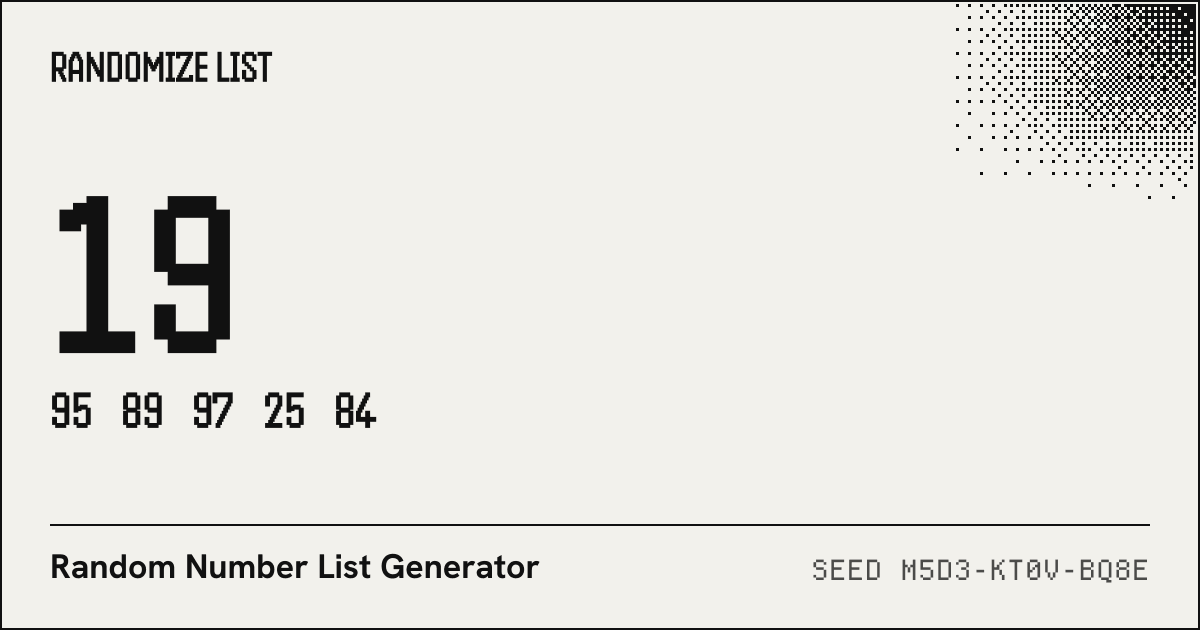
The sample above is 10 numbers from 1 to 100 with seed M5D3-KT0V-BQ8E: 19, 95, 89, 97, 25, 84, 2, 23, 37, 75. Type that seed under “Use your own seed” with the same settings and the same list appears again.
No repeats (unique numbers): a shuffled range
Asking for numbers without repeats, that is without duplicates, is the same as shuffling the whole range and keeping the first few. The generator does exactly that, but without writing out the range: it only remembers the positions it has swapped, so 10 numbers from 1 to a billion take no more memory than 10 numbers from 1 to 100. The count cannot be larger than the range, since 1 to 50 holds only 50 different numbers.
| Range | Numbers | Without repeats | With repeats |
|---|---|---|---|
| 1 to 10 | 3 | 720 | 1,000 |
| 1 to 49 | 6 | 10,068,347,520 | 13,841,287,201 |
| 1 to 100 | 5 | 9,034,502,400 | 10,000,000,000 |
| 1 to 100 | 10 | 6.28 × 10¹⁹ | 1020 |
| 1 to 1,000 | 10 | 9.56 × 1029 | 1030 |
With repeats: how soon a number comes up twice
With repeats every number is drawn independently from the full range, and a repeat turns up much sooner than intuition suggests. This is the birthday problem: 23 people are enough for an even chance that two share a birthday. The table gives the chance of at least one repeat for a few ranges and list lengths.
| Range | Numbers drawn → chance of a repeat |
|---|---|
| 1 to 10 | 3 → 28.0% · 5 → 69.8% · 8 → 98.2% |
| 1 to 100 | 5 → 9.7% · 10 → 37.2% · 20 → 87.0% · 30 → 99.2% |
| 1 to 365 | 10 → 11.7% · 23 → 50.7% · 40 → 89.1% |
| 1 to 1,000 | 10 → 4.4% · 38 → 50.9% · 100 → 99.4% |
If a repeat would spoil the result, such as raffle ticket numbers or seat numbers, leave repeats off; to put the people themselves into groups, the random team generator splits a list of names directly. For lottery style draws the order as drawn matters; for picking rows to audit, sorted is easier to work through. Numbers are chosen without bias towards either end of the range; how the draw works explains how. In a spreadsheet, RANDBETWEEN and RANDARRAY do a similar job, covered in the Excel and Google Sheets guide.
Questions about random number lists
How do I generate random numbers from 1 to 100 in Excel?
Type =RANDBETWEEN(1,100) in a cell and fill it down; numbers may repeat. In Excel for Microsoft 365 or Excel 2021, =RANDARRAY(10,1,1,100,TRUE) returns ten whole numbers at once. For numbers that never repeat, shuffle =SEQUENCE(100) with SORTBY and RANDARRAY and keep the first ten rows.
How do I get random numbers with no repeats (no duplicates)?
Turn off repeats. Each number in the range can then appear once at most, which is the same as shuffling the whole range and keeping the first numbers. The count cannot be larger than the range: 1 to 50 holds only 50 different numbers.
How likely is a repeat when repeats are allowed?
Higher than most people expect. Ten numbers from 1 to 100 contain at least one repeat about 37% of the time, and 23 numbers from 1 to 365 about 51% of the time; that second case is the classic birthday problem.
Can the range include negative numbers?
Yes. Any whole numbers work as limits, for example −50 to 50, as long as the lowest is not above the highest.