Random Letter Generator
A random letter generator picks letters from the 26 of the English alphabet with equal chances: all 26, only the five vowels or only the consonants, with Y counted either way. Choose how many letters you need and press Generate letters; 26 with repeats off gives the whole alphabet in a random order.
Result
- 01 W Whiskey
- 02 F Foxtrot
- 03 E Echo
- 04 C Charlie
- 05 D Delta
How do I get random letters?
- Pick all 26 letters, only vowels or only consonants, and type any letters to leave out, such as Q and Z for a word game.
- Say how many letters you want and whether one may come up twice.
- Press Generate letters; switch the case to lower or mixed if the letters go on cards.
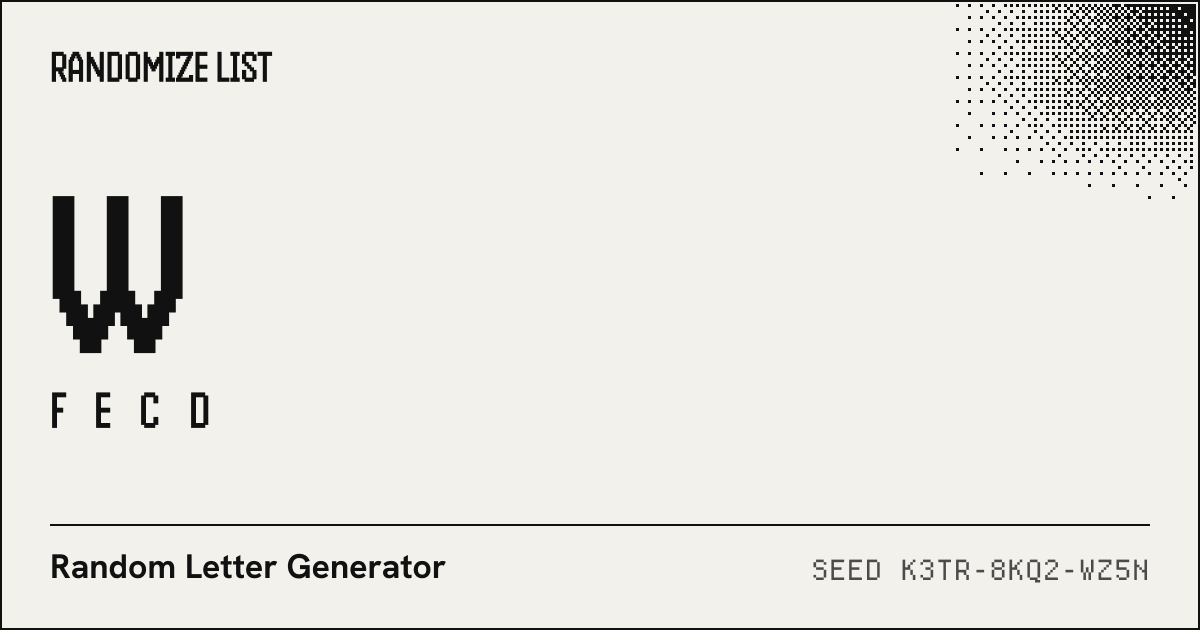
The sample above is 5 letters with seed K3TR-8KQ2-WZ5N: W, F, E, C, D (Whiskey, Foxtrot, Echo, Charlie, Delta). The same seed with the same settings brings back those letters in that order, so a teacher can prepare a spelling round at home and replay it in class. If the letters you need are not A to Z, for example Scrabble tiles or the letters of a name, paste your own list into the list randomizer instead.
Random alphabet generator: all 26 letters in a new order
Set How many to 26 and leave Allow repeats off: each letter then appears exactly once, and the result is the alphabet shuffled. With the sample seed it comes out as W F E C D N X T I O V A M P S H Z L U K J B Y Q R G. The alphabet can be arranged in 26 × 25 × … × 1 = 26! different ways, which is 4.03 × 1026 orders, or exactly 403,291,461,126,605,635,584,000,000. Each of them is equally likely, because the letters are put in order with the same Fisher–Yates shuffle the rest of the site uses.
The 26 letters and how they are grouped
The generator works from the 26 letters of the basic Latin alphabet used for English: 5 vowels (A, E, I, O, U), 20 consonants and Y, which sits in a group of its own because it can be either. Tick Count Y as a vowel and Y joins the vowels; leave it unticked and Y is drawn with the consonants. Letters typed into Leave out are removed before the draw, whatever group they belong to.
| Letter | Group | Code word |
|---|---|---|
| A a | Vowel | Alfa |
| B b | Consonant | Bravo |
| C c | Consonant | Charlie |
| D d | Consonant | Delta |
| E e | Vowel | Echo |
| F f | Consonant | Foxtrot |
| G g | Consonant | Golf |
| H h | Consonant | Hotel |
| I i | Vowel | India |
| J j | Consonant | Juliett |
| K k | Consonant | Kilo |
| L l | Consonant | Lima |
| M m | Consonant | Mike |
| N n | Consonant | November |
| O o | Vowel | Oscar |
| P p | Consonant | Papa |
| Q q | Consonant | Quebec |
| R r | Consonant | Romeo |
| S s | Consonant | Sierra |
| T t | Consonant | Tango |
| U u | Vowel | Uniform |
| V v | Consonant | Victor |
| W w | Consonant | Whiskey |
| X x | Consonant | X-ray |
| Y y | Vowel or consonant (your choice) | Yankee |
| Z z | Consonant | Zulu |
How likely is at least one vowel?
Word games often need a vowel in the hand. The chance of getting at least one among k random letters depends on whether letters may repeat and on where Y goes. With repeats every pick is a fresh 5-in-26 chance (6 in 26 with Y as a vowel), so the chance of no vowel at all is (21/26)k. Without repeats each consonant drawn makes a vowel a little more likely next time, which is why that column grows slightly faster.
| Letters (k) | Repeats, Y consonant | No repeats, Y consonant | Repeats, Y vowel | No repeats, Y vowel |
|---|---|---|---|---|
| 1 | 19.2% | 19.2% | 23.1% | 23.1% |
| 2 | 34.8% | 35.4% | 40.8% | 41.5% |
| 3 | 47.3% | 48.8% | 54.5% | 56.2% |
| 4 | 57.4% | 60.0% | 65.0% | 67.6% |
| 5 | 65.6% | 69.1% | 73.1% | 76.4% |
| 6 | 72.2% | 76.4% | 79.3% | 83.2% |
Reading letters out: the NATO code words
Over a phone line B and D, or M and N, are easy to confuse, so each letter can be shown with its code word from the NATO phonetic alphabet: Alfa for A, Bravo for B, through to Zulu. The spellings follow NATO’s own page on the alphabet, which writes Alfa and Juliett rather than Alpha and Juliet. The same page records that NATO first planned the alphabet for 1 January 1956 and that the Allies were told on 21 February 1956 it would be made effective in NATO on 1 March 1956. The code words are display only: turning them on or off never changes which letters are drawn.
Up to 1,000 letters fit in one draw when repeats are allowed, enough for a page of random letters to practice handwriting or typing; without repeats the limit is the number of letters left after the filters.
A random letter in Excel or Google Sheets
In a spreadsheet one random capital letter is a single formula, =CHAR(RANDBETWEEN(65,90)): RANDBETWEEN draws a whole number from 65 to 90, and CHAR turns it into the character with that code, A for 65 through Z for 90 (CHAR in Excel, CHAR in Google Sheets). Use 97 to 122 for lower case. The formula draws again every time the sheet recalculates and has no seed, so a result cannot be replayed; the guide to randomizing a list in Excel shows how to freeze it with Paste Values.
List checked against NATO on .
Questions about random letters
What are random letters?
Random letters are letters chosen by chance rather than by a person, each with the same probability. On the random letter generator they come from A to Z, or only from the vowels or the consonants, and every draw has a seed: the same seed with the same settings gives the same letters again.
How do I get the alphabet in a random order?
To get the alphabet in a random order with the letter generator, set How many to 26, leave Allow repeats off and press Generate letters. Every letter appears exactly once, in one of about 4.03 × 10²⁶ possible orders.
Is Y a vowel or a consonant here?
In the random letter generator Y counts either way, and you choose. By default Y is drawn with the consonants; tick Count Y as a vowel and it moves to the vowels. That changes the odds a little: the chance of at least one vowel among 3 letters without repeats rises from 48.8% to 56.2%.
Can I leave some letters out?
Yes. The letter generator removes the letters typed into Leave out before the draw, so they can never come up: type them in either case, with or without spaces or commas, for example Q X Z. Anything that is not a letter is ignored, and the field shows the letters it used after each draw.