Random Team Generator
Paste the names, choose how many teams you need or how many people go in each, and press Draw. This random group generator shuffles the list and deals it like cards, so sizes differ by one at most unless you choose a smaller last team. Put an asterisk before a captain; captains always land on different teams.
List options
Use your own seed
The same list, settings and seed always give the same result. A code such as K7Q2-9MXD-4HCZ is read in any case; other text is used exactly as typed.
Ctrl + Enter draws; R draws again when you are not typing.
Result
Paste a list and press Draw. The result appears here, the first name largest.
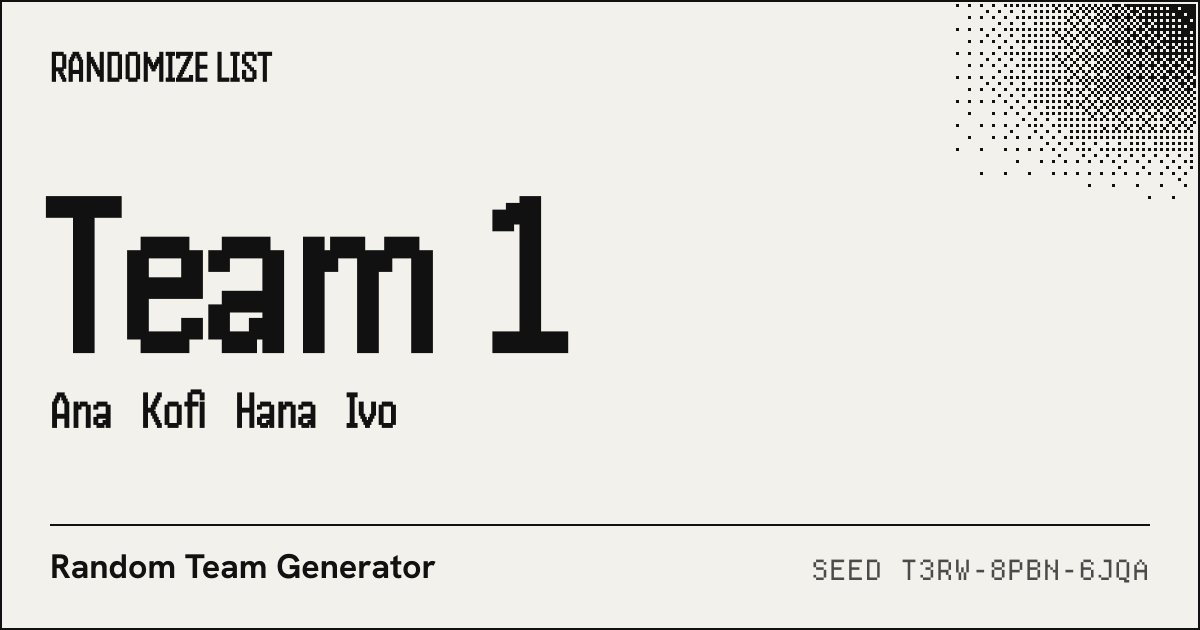
01 · 4 people Team 1
- Ana lead
- Kofi
- Hana
- Ivo
02 · 4 people Team 2
- Ben lead
- Chloe
- Farah
- Gus
03 · 4 people Team 3
- Lena
- Jade
- Eli
- Dev
Anyone with the link can see the list. The part after # is not sent to any server.
Recent draws on this device
How do I make random teams or groups?
- Paste the class or squad list, one name per line. A column copied from a register or a spreadsheet works as it is.
- Choose Teams, then either the number of teams or the number of people in each.
- Optionally put * in front of the captains, or of the two strongest players, so they end up on different teams. To choose the captains at random first, draw them with the name picker.
- Press Draw. Read the teams off the screen, or press Share link so each group can open the same split on their phones.
How are team sizes chosen for 20 to 32 people?
By number of teams, the generator never lets two teams differ by more than one person. The table below is what it produces for groups of 20 to 32; “2 × 7, 1 × 6” means two teams of seven and one of six. The larger teams always come first, so Team 1 is never the short one by surprise.
| People | 2 teams | 3 teams | 4 teams | 5 teams | 6 teams | 7 teams | 8 teams |
|---|---|---|---|---|---|---|---|
| 20 | 2 × 10 | 2 × 7, 1 × 6 | 4 × 5 | 5 × 4 | 2 × 4, 4 × 3 | 6 × 3, 1 × 2 | 4 × 3, 4 × 2 |
| 21 | 1 × 11, 1 × 10 | 3 × 7 | 1 × 6, 3 × 5 | 1 × 5, 4 × 4 | 3 × 4, 3 × 3 | 7 × 3 | 5 × 3, 3 × 2 |
| 22 | 2 × 11 | 1 × 8, 2 × 7 | 2 × 6, 2 × 5 | 2 × 5, 3 × 4 | 4 × 4, 2 × 3 | 1 × 4, 6 × 3 | 6 × 3, 2 × 2 |
| 23 | 1 × 12, 1 × 11 | 2 × 8, 1 × 7 | 3 × 6, 1 × 5 | 3 × 5, 2 × 4 | 5 × 4, 1 × 3 | 2 × 4, 5 × 3 | 7 × 3, 1 × 2 |
| 24 | 2 × 12 | 3 × 8 | 4 × 6 | 4 × 5, 1 × 4 | 6 × 4 | 3 × 4, 4 × 3 | 8 × 3 |
| 25 | 1 × 13, 1 × 12 | 1 × 9, 2 × 8 | 1 × 7, 3 × 6 | 5 × 5 | 1 × 5, 5 × 4 | 4 × 4, 3 × 3 | 1 × 4, 7 × 3 |
| 26 | 2 × 13 | 2 × 9, 1 × 8 | 2 × 7, 2 × 6 | 1 × 6, 4 × 5 | 2 × 5, 4 × 4 | 5 × 4, 2 × 3 | 2 × 4, 6 × 3 |
| 27 | 1 × 14, 1 × 13 | 3 × 9 | 3 × 7, 1 × 6 | 2 × 6, 3 × 5 | 3 × 5, 3 × 4 | 6 × 4, 1 × 3 | 3 × 4, 5 × 3 |
| 28 | 2 × 14 | 1 × 10, 2 × 9 | 4 × 7 | 3 × 6, 2 × 5 | 4 × 5, 2 × 4 | 7 × 4 | 4 × 4, 4 × 3 |
| 29 | 1 × 15, 1 × 14 | 2 × 10, 1 × 9 | 1 × 8, 3 × 7 | 4 × 6, 1 × 5 | 5 × 5, 1 × 4 | 1 × 5, 6 × 4 | 5 × 4, 3 × 3 |
| 30 | 2 × 15 | 3 × 10 | 2 × 8, 2 × 7 | 5 × 6 | 6 × 5 | 2 × 5, 5 × 4 | 6 × 4, 2 × 3 |
| 31 | 1 × 16, 1 × 15 | 1 × 11, 2 × 10 | 3 × 8, 1 × 7 | 1 × 7, 4 × 6 | 1 × 6, 5 × 5 | 3 × 5, 4 × 4 | 7 × 4, 1 × 3 |
| 32 | 2 × 16 | 2 × 11, 1 × 10 | 4 × 8 | 2 × 7, 3 × 6 | 2 × 6, 4 × 5 | 4 × 5, 3 × 4 | 8 × 4 |
When the names do not divide evenly
Asking for teams of a fixed size raises a different question: what to do with the people left over. The default, spread, makes as many teams as the size requires and then evens them out, so no team is more than one short. Smaller last team keeps every other team at full size and leaves the remainder together. Teams of four show the difference best:
| People | Teams of 4, spread | Teams of 4, smaller last team |
|---|---|---|
| 21 | 4 · 4 · 4 · 3 · 3 · 3 | 4 · 4 · 4 · 4 · 4 · 1 |
| 22 | 4 · 4 · 4 · 4 · 3 · 3 | 4 · 4 · 4 · 4 · 4 · 2 |
| 23 | 4 · 4 · 4 · 4 · 4 · 3 | 4 · 4 · 4 · 4 · 4 · 3 |
| 25 | 4 · 4 · 4 · 4 · 3 · 3 · 3 | 4 · 4 · 4 · 4 · 4 · 4 · 1 |
| 26 | 4 · 4 · 4 · 4 · 4 · 3 · 3 | 4 · 4 · 4 · 4 · 4 · 4 · 2 |
| 27 | 4 · 4 · 4 · 4 · 4 · 4 · 3 | 4 · 4 · 4 · 4 · 4 · 4 · 3 |
| 29 | 4 · 4 · 4 · 4 · 4 · 3 · 3 · 3 | 4 · 4 · 4 · 4 · 4 · 4 · 4 · 1 |
| 30 | 4 · 4 · 4 · 4 · 4 · 4 · 3 · 3 | 4 · 4 · 4 · 4 · 4 · 4 · 4 · 2 |
Spread suits games and group work, where a team of two against teams of four is unfair. Smaller last team suits fixed seats, such as tables of four, where the last table simply has spare chairs. If people only need a seat each rather than a team, draw seat numbers with no repeats on the random number list generator.
The sample draw with two captains, explained
The list above holds 12 names, and Ana and Ben are marked with * as captains. With seed T3RW-8PBN-6JQA and 3 teams, the captains were seated first, one per team: Ana leads Team 1, Ben leads Team 2. Everyone else was put in order by a Fisher–Yates shuffle and dealt round the table like cards, skipping any team that is already full, so with 12 people and 3 teams the sizes come out as 4, 4, 4. A third team got no captain, because only two names were marked; marking more captains than there are teams is refused with a message rather than silently ignored.
Team names are optional. Type them separated by commas, such as Red, Blue, Green, and they replace Team 1, Team 2 and Team 3 in the same order. The shuffle itself does not change, so the same seed gives the same people under the new names. Why the deal is fair, and what the seed proves, is covered in how the draw works.
Questions about random teams and groups
How do you use a random group generator?
Paste one name per line, choose the number of groups or the number of people per group, and press Draw. Press it again for a new mix, or share the link so everyone sees the same groups.
What are the different types of random group generators?
Most split a list either into a set number of groups or into groups of a set size. Some also let you name captains who must end up on different teams, and some try to balance teams by skill or gender. This generator does count, size and captains (names marked with *); it does not balance by skill.
What happens when the names do not divide evenly?
By number of teams, the extra people go one each to the first teams, so sizes differ by one at most. By team size, 22 people in teams of 4 become six teams of 4, 4, 4, 4, 3 and 3; choose “smaller last team” to get five teams of 4 and one of 2 instead.
Can I pick captains so they end up on different teams?
Yes. Put an asterisk before each captain’s name, such as *Maya. Captains are shuffled and placed one per team before anyone else is dealt, so two captains never share a team. You can mark at most as many captains as there are teams. To choose the captains themselves at random, draw them first with the name picker.